
KRINAVI TRIP FIT
KRINAVI Trip Fit
70/100How many days in Busan for a first trip? Count your full days first。 Judge the complete door-to-door route and changeable details first; do not decide from attraction fame or one headline price alone.
- Time efficiency80/100
- Route fit70/100
- Planning flexibility65/100
- Weather resilience65/100
- Crowd control65/100
- Value for cost65/100
Visible dimensions organize the page conditions across time, route, booking, weather, crowds, and cost; each uses five-point increments and the total is their mean.
Check before departure: Recheck official hours, prices, reservations, service, weather limits, and same-day crowd notices before departure.
Before deciding how many nights to stay in Busan, do not open an attraction list. Put your flight or KTX arrival, hotel check-in and airport process before departure into the calendar, then count the full days left. Two nights usually leave roughly one full day; three nights usually leave two; only four nights add a third day that can be freely planned. This is not a fixed travel formula, but the basic arithmetic after arrival and departure cut into the trip. Add a night only when it serves the east side, old city, an event day or a weather alternative—not merely because “you may not come again.”
Before adding a night, name the day it needs to serve
- Arrival and departure: Have your flight or train times already consumed the first or last half-day? Fix the hotel and airport end first, then count full days.
- Two directions: The west side’s old city, harbour and markets need one day; the east side’s coast needs another. With only one full day, do not chase both.
- Fixed dates: When an exhibition, show, swimming season or reserved activity is locked to a day and area, treat it as a full day rather than squeezing it between attractions.
- A fourth night: It should buy a weather backup, an intercity day or an evening in one complete hotel area; otherwise three nights may be enough.
This guide does not declare one ideal number of nights for everyone. Airport buses, events and beach-season details change, so recheck them for your dates before departure.
Subtract the arrival day first—getting to Busan is not the same as starting Busan
Between Gimhae Airport or Busan Station and your hotel, there is still luggage, the final transfer and check-in. Gimhae Airport buses currently separate Seomyeon/Bujeon and Haeundae/Gijang into different routes with different service windows; this affects how much of arrival day remains, and cannot be reduced to a generic “city transfer.” If accommodation is undecided, first read how to get from Gimhae Airport into Busan and match your actual landing time to the area where you get off.
Likewise, arriving by KTX does not mean arriving at your hotel door. If you reach Busan in the evening, protect check-in and dinner rather than squeezing in the most distant area. This does not waste the first night; it makes the next day complete instead of beginning with fatigue and recovery. When transferring from Seoul, first read the Seoul-to-Busan KTX first-night plan, then return to decide whether two nights truly remain.
Two nights: one full day means choosing one direction
The point of two nights is not whether you can “do Busan,” but whether you are willing to let one full day serve only one side. If you want markets, harbourfront, old city and food, keep that day on the west side; if you want beach, dinner and a night walk to connect, make the east side your only full day. Touching both sides usually cuts your one complete day into transport segments. Once you know you have only one or two nights, read whether a short Busan trip should use the west or east side; it places arrival/departure combinations, the one full day and hotel location on the same calendar.
Your hotel must match that choice. Haeundae or Gwangalli make sense only if you will use the coast in the morning and evening; if the beach is one daytime outing, a Seomyeon or Nampo base may be no worse. If your area is still undecided, read where to stay in Busan; if you already know you want the coast, go straight to Haeundae accommodation for the next address and room-type decision.
Three nights: two full days finally let you split east and west
What three nights add over two is not simply another evening for late-night food, but usually a second full day. Only then can one day on the west side and one on the east side stop competing for time. Keep arrival and departure days for the hotel area, luggage and one thing you genuinely want to do; do not pretend every day is equally long.
Once two full days have distinct directions, be more restrained with accommodation. With three nights, choose one main base first; do not cut the middle day into checkout and check-in just to sleep in both Seomyeon and Haeundae. Consider splitting only when the new base serves the following two nights in a row or removes a confirmed airport/event friction. When two days are set, next read how a three-day Busan itinerary groups the east and west sides.
Four nights: the extra day should have a name
A fourth night is worthwhile only when you can say what the extra day is for. It may be a weather-substitution day: if the planned coast day has poor conditions, you do not have to compress another direction. It may be a fixed-event day, when an exhibition, match or performance locks a day to one area. Or it may be an intercity day, so a trip to Gyeongju or Seoul does not steal an existing full Busan day.
That is different from adding another string of attractions. The general-public days for Busan Indie Connect Festival BIC 2026 are 15–16 August at BEXCO; a dated, venue-specific event like this is a clear example of what an extra night can serve. If the event is already on your calendar, read where to stay for a BEXCO event day to handle the post-event return and your base, rather than treating BEXCO as just another attraction. Check event dates against the official BIC information; after the event ends, do not use it to justify an extra night in an ordinary itinerary.
October is similar, but on a larger scale: the 2026 Busan International Rock Festival runs for three consecutive days at Samnak Ecological Park. If you already have a three-day pass, this is no longer simply a question of whether night four has an activity: three full days and three post-event nights are fixed. At that point, open where to stay for the 2026 Busan International Rock Festival and verify ticket type, shuttles and whether consecutive event days truly require a base change.
Beach season changes whether the east side has a fixed time window
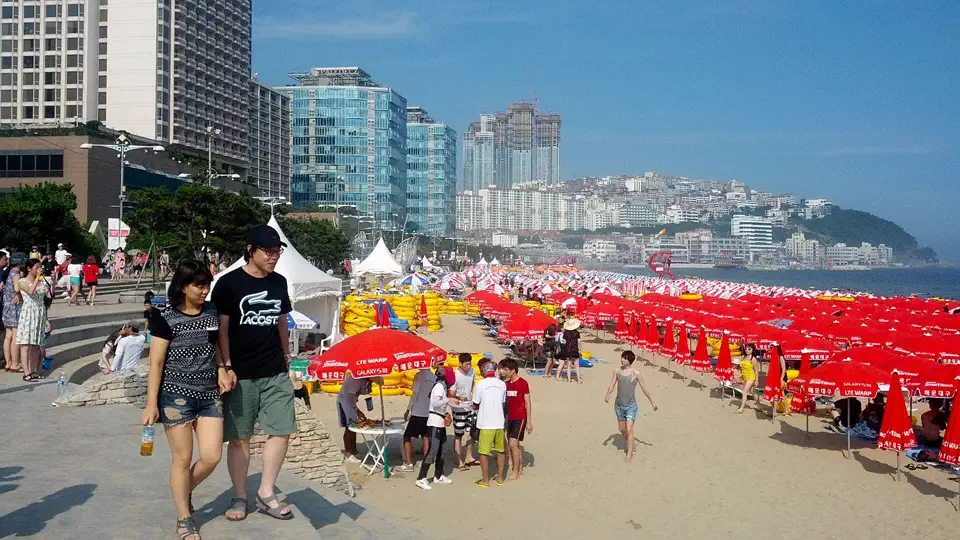
Haeundae Beach is not the same itinerary all year. Busan City lists the 2026 swimming season as 26 June to 15 September, 09:00–18:00 daily. This does not mean you cannot visit the coast outside the season, or that everyone needs to swim; it simply means that if your purpose is genuinely to use the beach during opening hours, that fixed window makes the east-side day harder to mix with the west side.
If you plan to use beach hours, put them into a complete east-side day first; only then can accommodation help in the morning, for changing and in the evening. If you only want a walk or sea view, do not let seasonal hours govern the whole trip. Recheck beach facilities and current-season information through Busan City’s Haeundae Beach page.
Whether an extra night means changing hotels is a separate question
Four or more nights certainly leave more room for Seomyeon and Haeundae to serve different stretches, but extra nights do not automatically require a hotel move. First ask whether at least two consecutive nights will be spent on the same side; if not, a fixed base is better at absorbing weather, dinners and changes from companions. What splitting hotels saves, and what the extra night is for, are two different decisions.
If four nights are confirmed and you genuinely want to divide the east and west sides, next read whether to change hotels in Busan. Put checkout, luggage and the nights when the new base will be used continuously side by side before deciding to move.
You also do not need to split accommodation immediately just because you have held a fourth night. Keep that day under a cancellable room first, then decide once the event, weather or intercity plan is real. This is easier than locking every night into a different area at the start, because the extra day is there to absorb change, not create another move.
Finally, write the number of nights as one sentence
Two nights: I need only one complete direction, and I will not pretend arrival and departure days can sightsee. Three nights: I have two full days, one for the west side and one for the east. Four nights: I gain a day for a confirmed event, an intercity transfer, a weather substitution or simply staying longer—not another distant attraction. If you cannot write one of these sentences, do not book an extra night yet.
Once the number of nights is fixed, go to Busan hotel comparisons to set dates, guest count, bed type and cancellation terms. Accommodation pages are for after you decide how many nights to stay; letting one hotel price decide the length of the entire trip often hides the full days the itinerary actually needs.
Next: confirm which question beyond nights is still blocking you
KriNavi decision card
Best use of this page: How many days in Busan for a first trip? Count your full days first
Core judgement: Choosing two, three or four nights in Busan? Subtract arrival and departure time first, then use full. Plan the route around realistic timing and transport.
Sources checked in this page: Source 1 · Source 2
This card only reorganizes sources already listed by the page. Recheck live hours, prices, service, and restrictions for the travel date.