
KRINAVI TRIP FIT
KRINAVI Trip Fit
75/100Hotel tt Seomyeon: Not just a stones throw from Seomyeon Station—its real value lies between two stations。 Judge the complete door-to-door route and changeable details first; do not decide from attraction fame or one headline price alone.
- Time efficiency75/100
- Route fit75/100
- Planning flexibility75/100
- Weather resilience70/100
- Crowd control70/100
- Value for cost75/100
Visible dimensions organize the page conditions across time, route, booking, weather, crowds, and cost; each uses five-point increments and the total is their mean.
Check before departure: Recheck official hours, prices, reservations, service, weather limits, and same-day crowd notices before departure.
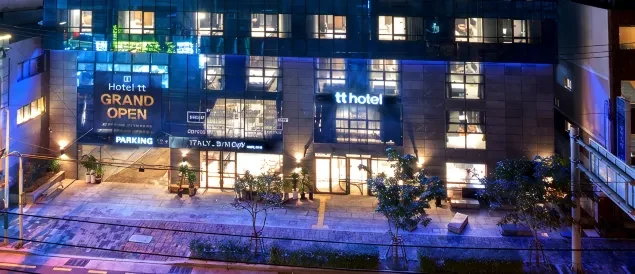
Hotel tt Seomyeon earns a special case for inclusion not because it’s merely close to Seomyeon Station, but because it sits between Seomyeon Station and Busan’s Donghae Line Busan–Haedong Station. Korean tourism data currently positions it this way; Seomyeon Station serves both Busan Metro Lines 1 and 2, while NAVER’s station data marks the other end, Busan–Haedong, as an East Coast Line station. The real question isn’t “there are two stations nearby,” but whether your itinerary would actually use a second transport system.
| Travel day | Destination | Most natural departure point |
|---|---|---|
| Day 1 | Namcheon / Busan Station direction | Seomyeon Station |
| Day 2 | Osiria / East Coast Line direction | Busan–Haedong Station may enter thecandidate options |
| Day 3 | Gwangalli / City Hall Line 2 direction | Seomyeon Station |
If after filling in your itinerary Busan–Haedong Station never appears, the dual-station advantage becomes Unused Optionality: present, but not used.
One more station on the map does not equal one more travel option
The biggest overestimate for Hotel tt is translating “two stations nearby” into “transportation twofold convenience.” That’s just the first layer; the second layer is whether the route is truly useful, and the third is whether you will actually walk to that station. Only when all three layers hold true does the second station become part of the lodging product.
There’s also a naming pitfall: the booking page currently lists both Metro: Bujeon and Train: Bujeon Station. The “second station” discussed here is Busan–Haedong Station on the East Coast Line, not treating Haedong as a separate tool for Busan Metro Line 1. Before booking, clearly distinguish station functions, otherwise you risk counting an extra transfer on the map.
Seomyeon Station and Busan–Haedong Station are not rivals; they are two different tools
Seomyeon Station’s strength lies in the urban metro transfers between Lines 1 and 2. Busan–Haedong Station adds value on the East Coast Line. For Hotel tt, it isn’t about which station is better; it’s about which tool you’ll need for tomorrow’s destination.
| Destination direction | Which node to compare first | Key considerations |
|---|---|---|
| Busan Station / Namcheon | Seomyeon Station Line 1 | Urban north-south movement without detouring to Busan–Haedong just to use the second station |
| Gwangalli / along Line 2 | Seomyeon Station Line 2 | Using the existing metro tools is usually more intuitive |
| BEXCO | Both sides matter | BEXCO connects to both Line 2 and East Coast Line; having a second route doesn’t guarantee faster travel |
| Osiria / East Coast Line east side | Busan–Haedong Station worth including in comparison | Visit Busan’s current transit data clearly lists Osiria as East Coast Line station; this kind of itinerary magnifies the value of a second node |
| Haeundae Beach | Compare by actual end point | Heading east does not automatically mean choosing East Coast Line; if your end point is near Haeundae Station, Line 2 may be simpler |
So, if the second-day morning NAVER Map suddenly directs you toward Busan–Haedong, don’t read it as “Hotel tt has a special transportation magic.” The meaningful bit is: does this route reduce one transfer, reduce backtracking, or get you closer to your day’s end point?
Going to Osiria just once can be a convenience, not a guarantee
If Osiria is visited only once in your itinerary, Busan–Haedong Station provides a One-off Benefit. It can be advantageous, but insufficient by itself to decide on three or four nights. If you have other East Coast Line itineraries on different days, and the second station appears repeatedly, then a Repeated Benefit emerges.
Conversely, if your eastern schedule could be completed smoothly from Seomyeon Station’s Line 2, Busan–Haedong Station is mainly a nice fallback on the map. Don’t treat a potential use as time saved simply because it might be useful.
Using both tools is possible, but you pay in route complexity
The official Korea tourism page says the hotel sits between two stations, and that carries a trade-off: you gain options, but you’ll still need to walk a stretch each time. Current third-party platforms estimate Seomyeon Station at roughly 450 meters, about a 6–7 minute walk; Expedia’s Busan Bujeon Station estimate is about 8–9 minutes, the booking page lists around 520 meters in a straight line. These are not permanent “actual walking times”; exits, crossings, construction, rain, and which entrance you end up at can all change the feel of the journey.
If you’re traveling with large luggage, with seniors, or with kids, more options can increase the Route Complexity Cost: daily decisions about which station, which entrance, which train to take. If you prefer a fixed route, a hotel closer to a single station may be less mentally taxing. Regarding elevators/escalators and accessible entrances, NAVER station pages do not provide enough verified walking paths from Hotel → platform; this article does not claim to have tested them. Before departure, verify with NAVER/Kakao’s actual walking navigation and stationexit information.
The second station will only be useful if you actually use it; bring room types and breakfast into the checkout
Once the location value is established, Hotel tt gains a second buying reason: current Korean tourism data lists 8 room types across 103 rooms; the booking page currently shows Standard Double/Twin, Deluxe Double/Twin/Triple, Family Twin, Junior Suite, Royal Suite, among others. For group stays, don’t rely on bed count alone: Booking and Expedia’s current pages may show different maximum occupancy for certain room types. The safest approach is to input your actual number of guests and compare the same purchasable room type.
| Room-type direction | Currently visible bed configurations | What to double-check before payment |
|---|---|---|
| Standard Double / Twin | 1 Queen / 2 Singles | Basic needs for two, cancellation terms |
| Deluxe Twin | 1 King + 1 Single | Actual occupancy limit; don’t infer people from bed count |
| Deluxe Triple | 1 Queen + 2 Singles | Platform occupancy limits vary; must search with your party size |
| Family Twin | 1 Queen + 1 Small Double / other bed types shown on platform | Bed type name and actual occupancy |
| Junior / Royal Suite | Multi-bed configurations | Whether you really need a larger room instead of upgrading just because it sleeps more |
Breakfast is a secondary consideration. independent sources’s Policy block currently notes Buffet, 07:30–09:30, extra charge for adults; while the same page’s Property Description still says “weekends 07:00–09:30.” This discrepancy shows that breakfast times, charges, and inclusions depend on the Rate Plan and hotel confirmation at payment time, not on old reviews.
If your itinerary truly uses both Seomyeon Station and Busan–Haedong Station on the same dates, then compare Hotel tt across those dates with the same room type. If you will never use Busan–Haedong Station, remove the “close to Busan–Haedong” advantage first, and then see if the price still justifies the stay.

Take Busan–Haedong Station off the map
One final, straightforward mental experiment: if Hotel tt’s surroundings included only Seomyeon Station and Busan–Haedong Station didn’t exist at all, would you still choose it? If yes, it means the second station is a bonus and the hotel’s price, room types, or Seomyeon location already justify the choice.
If the answer is no, then revisit your itinerary: how many times would you actually use Busan–Haedong Station? If never, you’re giving extra credit to a potential benefit; if Day 2 or Day 4 clearly involves East Coast Line Busan–Haedong Station, then the second transport node truly becomes part of the lodging decision.
The most valuable scenario for Hotel tt Seomyeon isn’t having one more station on the map, but having an itinerary that genuinely turns away from Seomyeon Station for a day.
Next step
Not using Busan–Haedong Station? Return to Seomyeon hotel recommendations and re-rank candidates using the stations you actually use, late return times, and room types. If both stations are relevant, compare three OTAs on the same date, same guests, same bed type, same breakfast, and same cancellation terms.
Data sources and checks
Check date: 2026-08-10. Transit routes, room types, occupancy limits, breakfast, pricing and cancellation policies are all subject to change; this article does not treat OTA walking minutes as permanent travel times.
- 대한민국 구석구석 / Korea Tourism: Hotel tt Seomyeon location, 8 room types, 103 rooms
- NAVER: Seomyeon Station transfer between Lines 1 and 2
- NAVER: Busan–Haedong Station on East Coast Line
- Visit Busan: Osiria Station / East Coast Line transit
- the booking page: current room types, station distances, breakfast and policies
- the booking page: current room types and occupancy
- the booking page: current station distances, room types and breakfast
KriNavi decision card
Best use of this page: Hotel tt Seomyeon: Not just a stones throw from Seomyeon Station—its real value lies between two stations
Core judgement: Hotel tt Seomyeon sits between Seomyeon Station and the Donghae Line. Compare transfers, rooms and late-night return time before booking.
Sources checked in this page: Source 1 · Source 2 · Source 3 · Source 4
This card only reorganizes sources already listed by the page. Recheck live hours, prices, service, and restrictions for the travel date.