
Short answer: Bijarim Forest is a conservation-and-pace decision. The value is in moving quietly among old torreya trees and volcanic forest atmosphere, while the group must respect paths, weather, access, time and the difference between a forest walk and a checklist photo. Current hours, access, prices, reservations, transport, facilities, programmes, weather, closures and safety conditions are to be checked close to travel.
- the group names its purpose before choosing a route
- current access, transport, facilities and conduct rules are checked
- weather, mobility, attention and the least confident traveller shape the plan
- lodging and the next chapter are chosen by the complete route
What is the real choice?
Bijarim Forest is a place where the route should slow down. Visit Jeju and Korea Tourism Organization materials describe a rare forest of old Japanese torreya trees and a path that rewards quiet observation. The stable reason to go is the forest atmosphere and ecological story, not a promise that one exact ancient tree, scent or weather mood will appear. Current hours, admission, path condition, accessibility, parking, crowd controls and conservation notices must be checked. A rainy day may create a compelling atmosphere, but wet surfaces and visibility still need a safety decision. Choose a shorter route for a child, older traveller or anyone with fatigue. A Gujwa base can reduce driving; a full-island route turns the forest into one long road commitment. Do not touch, climb or stage a natural monument. The forest is the destination, and quiet behaviour is part of the route.
Route and decision table
| Route | Choose it when | Suggested sequence | Trade-off |
|---|---|---|---|
| Slow forest immersion | The group wants old trees, shade, sound and time rather than a rapid attraction stop. | Check current path, weather, hours and energy, then walk without a rigid photo list. | More atmosphere, but fewer distant Jeju stops fit the day. |
| Short accessible nature stop | The group needs a bounded route and clear rest or toilet plan. | Verify entrance, surfaces, main path, parking, seating and current accessibility. | Lower strain, but the group may not cover every loop. |
| Rain-safe forest chapter | Cloud or light rain makes the canopy attractive and the group accepts wet conditions. | Check warnings, surface, shoes and conservation notices before walking. | Atmospheric and cool, but slippery or closed paths can change the plan. |
| Gujwa base route | Bijarim is one anchor in an eastern Jeju stay. | Choose lodging by the next morning and add one checked contrast only. | Less driving, but current rural services and room choice may be narrower. |
Old trees are living evidence
Bijarim is not a collection of decorative trunks. The trees, soil, shade, moisture and surrounding species form a living place. Use the official interpretation for age, designation and ecology rather than making a dramatic claim from a photograph. Visitors should stay on marked paths, avoid touching roots or bark and keep voices low. Do not promise a particular tree will be visible if the route or conservation work changes. The forest still has value as a whole.
Rain changes the route, not the reason
A canopy can soften light rain and make the forest feel more enclosed, but water can also make volcanic-ash paths slick. Check warnings, footwear, drainage, umbrellas, visibility and closures. A group should be prepared to shorten the walk rather than treating rain as a guaranteed enhancement. If the forest remains open and safe, the weather can be part of the experience. If it does not, use a confirmed Gujwa or Jeju indoor alternative honestly.
Choose a loop by attention
Forest paths invite visitors to walk until they are tired, then hurry back. Set a time, distance or rest point before entering. Children can look for changes in bark, light or sound without touching anything. Older visitors may need benches and a shorter main path. Check current route maps and facilities for the actual person. A short, quiet loop often creates more memory than a complete circuit done while watching a car clock.
Accessibility needs current detail
The park may offer a barrier-free entrance, parking or main route according to tourism information, but access is segment-specific. Check surface, slope, toilets, rest, rental equipment, vehicle drop-off and any temporary work. Do not promise that every path suits a wheelchair, stroller or traveller with fatigue. Set a meeting point and a place to wait. The forest can be shared even when group members choose different distances.
Protect a natural monument from tourism pressure
No food, drones, climbing, loud speakers, litter or staged contact should be added without permission. Follow signs and staff. A visitor does not need to photograph a trunk from every angle to prove the forest was appreciated. Spread people along the path and yield to others. Conservation is not a restriction that reduces the experience; it is what lets the old forest remain available.
Eastern Jeju transport is a commitment
Gujwa and the forest are part of an island route where buses, taxis, parking, traffic and driving fatigue differ by base. Check the actual road, last link, parking, fuel and return. A car can make Bijarim flexible while also tempting the group to add too many distant stops. Public transport requires a realistic walk and service margin. Choose a base near the next chapter rather than chasing a nominally cheap room.
Pair by ecological contrast
A volcanic site, coast, village or sunrise chapter can contrast with the forest, but a full eastern Jeju list may turn nature into windshield time. Choose one current, feasible contrast and leave a quiet meal or rest. If the forest is absorbing, drop the add-on. A forest route should not be measured by the number of landscapes consumed.
Visit Jeju, KTO, the official guidebook and local notices can support the forest identity and broad route. Current hours, fees, access, parking, path works, crowd controls and conservation rules remain to be checked. Mark unknown claims accordingly. The stable promise is a slow, respectful forest decision, not an exact sensory or botanical guarantee.
Evidence notes for this decision
Route evidence note — Slow forest immersion: choose this when the group wants old trees, shade, sound and time rather than a rapid attraction stop. The practical sequence is Check current path, weather, hours and energy, then walk without a rigid photo list. The trade-off is More atmosphere, but fewer distant Jeju stops fit the day. Keep live access and operating details to be checked.
Route evidence note — Short accessible nature stop: choose this when the group needs a bounded route and clear rest or toilet plan. The practical sequence is Verify entrance, surfaces, main path, parking, seating and current accessibility. The trade-off is Lower strain, but the group may not cover every loop. Keep live access and operating details to be checked.
Route evidence note — Rain-safe forest chapter: choose this when cloud or light rain makes the canopy attractive and the group accepts wet conditions. The practical sequence is Check warnings, surface, shoes and conservation notices before walking. The trade-off is Atmospheric and cool, but slippery or closed paths can change the plan. Keep live access and operating details to be checked.
Route evidence note — Gujwa base route: choose this when bijarim is one anchor in an eastern jeju stay. The practical sequence is Choose lodging by the next morning and add one checked contrast only. The trade-off is Less driving, but current rural services and room choice may be narrower. Keep live access and operating details to be checked.
Spring evidence note: The opportunity is Fresh forest growth and mild air can support a slow shaded walk. The constraint is Rain, pollen and weekend demand can affect paths and quiet. Before leaving, Check access, surfaces, weather, hours, crowds and parking. This is a planning prompt, not a forecast.
Summer evidence note: The opportunity is Canopy shade can give an eastern Jeju route relief from open coast heat. The constraint is Humidity, sudden rain, traffic and crowds increase fatigue. Before leaving, Check water, warnings, shade, path, facilities and return. This is a planning prompt, not a forecast.
Autumn evidence note: The opportunity is Cooler air and changing forest colour can reward careful observation. The constraint is Shorter daylight and popular weekends reduce flexibility. Before leaving, Check daylight, demand, conservation notices and transport. This is a planning prompt, not a forecast.
Winter evidence note: The opportunity is A quiet forest can anchor a spare, rain-safe Jeju day. The constraint is Cold rain, wind, wet surfaces and closures weaken a long loop. Before leaving, Check clothing, path, hours, weather and an indoor fallback. This is a planning prompt, not a forecast.
Positive signal: The group chooses slow immersion, access, rain resilience or a Gujwa base purpose. Evidence should be current, specific and tied to the group's actual route.
Positive signal: Current path, hours, access, parking, weather and conservation guidance are checked. Evidence should be current, specific and tied to the group's actual route.
Positive signal: Old trees are treated as living protected landscape, not props. Evidence should be current, specific and tied to the group's actual route.
Positive signal: The walking loop fits the least confident traveller and the actual day. Evidence should be current, specific and tied to the group's actual route.
Positive signal: A closure or poor weather leaves a real eastern Jeju alternative. Evidence should be current, specific and tied to the group's actual route.
Limitation signal: A specific tree, age, scent or clear weather is promised without evidence. If this appears, shorten the promise or stop and verify.
Limitation signal: Visitors are encouraged to touch, climb, feed, drone or leave marked paths. If this appears, shorten the promise or stop and verify.
Limitation signal: A generic barrier-free label is used to promise every trail is accessible. If this appears, shorten the promise or stop and verify.
Limitation signal: Bijarim is combined with distant eastern stops without driving and rest margin. If this appears, shorten the promise or stop and verify.
Limitation signal: A past photograph is used as proof of current path or facility condition. If this appears, shorten the promise or stop and verify.
Four seasons at a glance
Seasonal trade-offs
| Season | What becomes attractive | What becomes harder | Check before committing |
|---|---|---|---|
| Spring | Fresh forest growth and mild air can support a slow shaded walk. | Rain, pollen and weekend demand can affect paths and quiet. | Check access, surfaces, weather, hours, crowds and parking. |
| Summer | Canopy shade can give an eastern Jeju route relief from open coast heat. | Humidity, sudden rain, traffic and crowds increase fatigue. | Check water, warnings, shade, path, facilities and return. |
| Autumn | Cooler air and changing forest colour can reward careful observation. | Shorter daylight and popular weekends reduce flexibility. | Check daylight, demand, conservation notices and transport. |
| Winter | A quiet forest can anchor a spare, rain-safe Jeju day. | Cold rain, wind, wet surfaces and closures weaken a long loop. | Check clothing, path, hours, weather and an indoor fallback. |
Five positive evidence signals
- The group chooses slow immersion, access, rain resilience or a Gujwa base purpose.
- Current path, hours, access, parking, weather and conservation guidance are checked.
- Old trees are treated as living protected landscape, not props.
- The walking loop fits the least confident traveller and the actual day.
- A closure or poor weather leaves a real eastern Jeju alternative.
Five negative evidence signals and limitations
- A specific tree, age, scent or clear weather is promised without evidence.
- Visitors are encouraged to touch, climb, feed, drone or leave marked paths.
- A generic barrier-free label is used to promise every trail is accessible.
- Bijarim is combined with distant eastern stops without driving and rest margin.
- A past photograph is used as proof of current path or facility condition.
Three practical route shapes
Quiet loop: protect time for trees, stay on path and leave the next chapter optional.
Rain gate: check surfaces and closure, then walk only if the forest remains safe.
Gujwa base: stay near the actual route and pair with one confirmed ecological contrast.
Accommodation and transport decision
| Stay shape | Choose it when | Trade-off |
|---|---|---|
| Gujwa base | Choose it when Bijarim and eastern Jeju are the main chapters. | Less driving, but current food, rooms and public transport need checking. |
| Jeju City base | Choose it when airport and city logistics matter to the wider island route. | More services, but the forest transfer is longer. |
| Seogwipo or full-island base | Choose it only when Bijarim is one checked day in a larger route. | Broad coverage, but road time and weather margin are lower. |
Field decisions before leaving
- m.visitjeju.net official or authoritative source — current operating details are to be checked.
- english1.visitkorea.or.kr official or authoritative source — current operating details are to be checked.
- www.visitjeju.net official or authoritative source — current operating details are to be checked.
- www.jeju.go.kr official or authoritative source — current operating details are to be checked.
FAQ
How long should I spend in Bijarim?
Choose a current loop or short section by attention, fitness and weather rather than a universal duration.
Can I visit in rain?
Possibly if the park is open and paths are safe; check warnings, surfaces and current notices.
Is it accessible?
Some access information may be available, but verify the actual entrance, path, toilets and facilities for the traveller.
Can I touch the old trees?
Stay on marked paths and follow conservation guidance; do not touch or climb natural monuments.
Where should I stay?
Compare Gujwa, Jeju City and a broader-island base against driving and the next day.
What if the forest closes?
Use a confirmed eastern Jeju alternative and do not describe a closed path as visited.
Stay for the forest rhythm, not just the entrance
Bijarim works best when the stay supports an early quiet walk, a rain-safe afternoon and a meal without a long cross-island transfer.
East Jeju base
Choose this when the forest, sunrise coast and short volcanic routes form one day. It keeps the morning drive short.
See east-coast staysJeju City base
Choose this when arrival, food and the next flight matter more. Make Bijarim one early route rather than a late detour.
See city-side staysStay east for the forest-and-coast loop; stay in the city for airport simplicity.
Put Bijarim early in an east Jeju day
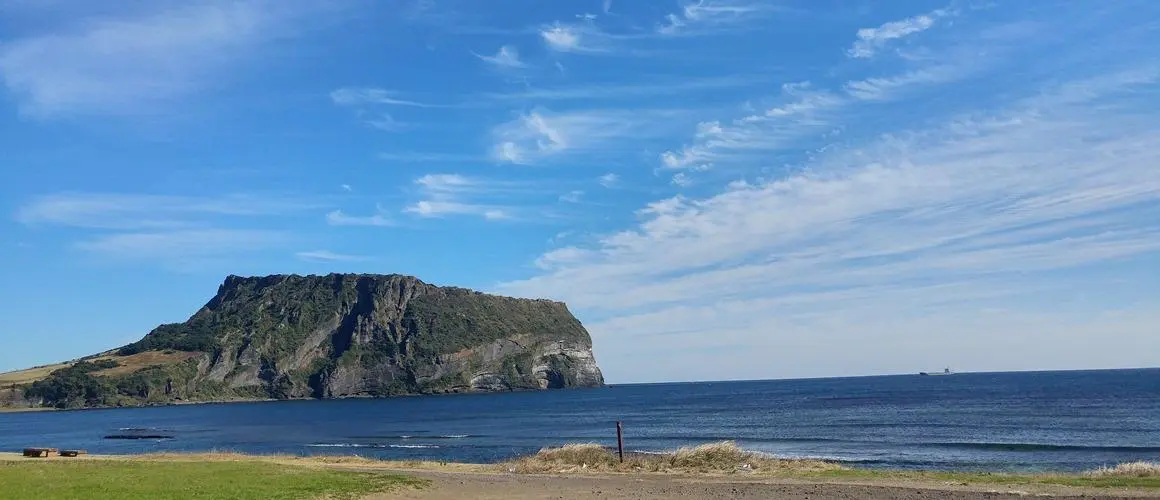
The forest needs quiet and usable legs, not the last slot after a chain of coastal transfers. From an east Jeju base, walk the shorter A route after breakfast, then decide whether B is worthwhile. Add only one short coast or Seongsan chapter afterward. From Jeju City, make Bijarim the one early eastern route; a second long shore can consume the time meant for the trees.
Spring and summer offer shade but also humidity and wet roots. Autumn light rewards a slow walk while weekends add entrance pressure. Winter can shelter part of the route from the sea wind, but grippy shoes and a warm layer still matter. For children, older travellers or a stroller, the short A version is a complete forest visit; B does not need to be completed for the day to count.
Give the forest and coast different rhythms
Bijarim is quiet, slow and shaded. The coast is exposed to wind, sun and vehicle time. Do not use the pace of a photo stop to judge the forest, and do not race from the trees to a distant sunset. Leave room for water, lunch and cleaning wet shoes before deciding on Seongsan, Seopjikoji or an early return to the room.
Choose the base for one fewer long transfer, a comfortable rainy pause and a simple next morning with luggage. Keep forest, coast, food and room as four sections that can shorten. That is what makes Bijarim a four-season Jeju nature loop rather than a one-weather detour.
KriNavi decision card
Best use of this page: Jeju Bijarim Forest Route Decision: Ancient Trees, Slow Walk or Rain-Safe Nature Stop?
Core judgement: Choose Bijarim Forest by slow walking, ancient trees, rain, accessibility, eastern Jeju transport, lodging and a flexible nature route.
Sources checked in this page: Source 1 · Source 2 · Source 3 · Source 4
This card only reorganizes sources already listed by the page. Recheck live hours, prices, service, and restrictions for the travel date.