
KRINAVI TRIP FIT
Score withheld

No numeric score is shown because this page does not yet have an external verification source. Use the planning checks, then confirm official information before booking or departure.
30-second answer: if you arrive late, leave early, travel without a car, or have no non-negotiable early commitment far from the airport, Jeju City or a short airport-side urban stay is usually the strongest one-night choice. Move east only when day one already finishes on the east coast and day two starts there again. Move west only when your sunset evening and following morning are both westbound. The south has the highest threshold: you need an early enough arrival, another south-side block the next morning, and a confirmed path back to the airport. One night should not be asked to rescue an itinerary that wants east, west, south and north at once.
Before opening a hotel app, write down two points. A is the last place on day one where you genuinely expect to stay through late afternoon, dinner, sunset or closing time. B is the first commitment on day two that has a clock attached to it: sunrise, ferry, reservation, airport departure, rental-car return or another fixed start. If A and B sit on the same travel line, put the hotel between them or closer to B. If A is in the west and B is in the east, the problem is not “find a central hotel.” The problem is that one of those anchors should leave the itinerary.
Stop calling it “two days” until you subtract the airport
Landing time is not usable sightseeing time. Korea Airports Corporation currently places regular city/intercity buses around Gate 2, taxis across from Gate 3, and the Route 600 limousine at Gate 5. Rental-car users still have to walk toward the Rental Car House area and take the relevant operator shuttle. That means baggage claim, terminal exit, waiting, rental handover or transit, the final hotel leg and check-in all sit between your aircraft and your first real stop. Departure day runs a similar chain in reverse.
For a 2D1N stay, think in three blocks instead: the usable arrival half-day, the one overnight seam, and the usable departure half-day. A late arrival plus an early flight can leave you with far less than one full leisure day. In that case, pushing the hotel far away for atmosphere usually damages both ends of the trip. If the arrival itself is the hard part, use the late-arrival first-night guide. If the outbound flight dominates the decision, use the early-flight last-night guide.
A north-side night is not “wasting Jeju”; it is buying the lowest-friction seam
If A is dinner in Jeju City, a Yeondong evening, the Yongdam coast or simply “get out of the airport and eat,” and B is a north-side morning, car return or flight, the north is usually doing exactly what the trip needs. Visit Jeju describes the Yongdam/Yongduam Coastal Road as an airport-north coastal stretch with hotels, cafes and restaurants. It can provide a little coastline without demanding a cross-island transfer before bed.
Once north is chosen, narrow the area with where to stay in Jeju and the airport-first-night decision rather than comparing the entire island again. At hotel level, Hotel Sirius Jeju is one existing property decision page, while Hotel Leo vs Hotel Sirius is useful when the real trade-off is between a more usable city evening and a more airport-oriented overnight. On a short trip, a city hotel does not need to impersonate a resort; it needs to make dinner, luggage, sleep and the next departure easy.
On the east, “Hamdeok overnight” and “Seongsan morning” are different products
The current Jeju bus timetable lists Route 101 along the airport–Jocheon–Gimnyeong–Seongsan–Namwon corridor. That gives the east a real transport spine, but a route existing does not guarantee a convenient stop at your hotel or remove the last mile with luggage. A no-car traveler can reasonably finish day one around Hamdeok and continue east the next morning. But if B is specifically sunrise at Seongsan, a ferry departure or an early Seongsan-area reservation, staying in Hamdeok may still leave a substantial morning transfer.
That is why “east Jeju” is too vague for one-night planning. First use the Seongsan east-side stay decision. If Hamdeok itself is the seam, compare Gloucester Hotel Hamdeok vs Ramada Jeju Hamdeok. If the morning clock is truly in Seongsan, go one level deeper with Co-op City Hotel Seongsan vs The Best Jeju Seongsan. The question is not which east-side hotel photographs better; it is which one deletes a real morning leg.
West Jeju only pays when you buy both the sunset and the following morning
Visit Jeju describes the Handam Coastal Walk as roughly 1.2 km along the Aewol coast and explicitly notes the west-side sunset appeal. That makes Aewol an excellent A: coffee, a coastal walk, sunset and dinner can close day one naturally. But if B is Hamdeok, Seongsan or an early airport obligation, day two starts by paying back the distance you borrowed the night before.
The current bus system lists Route 102 along Jeju Bus Terminal–airport–Aewol–Hallim–Daejeong, so a no-car west route does have a useful spine. For 2D1N, however, you still need the actual departure, stop and final hotel leg. If both A and B are westbound, use where to stay in western Jeju or the Aewol cafe-stay decision before looking at individual resorts. A one-night resort on the west coast only makes sense when it is part of the route, not a detour from it.
The south has a direct airport spine, but the time threshold is much higher
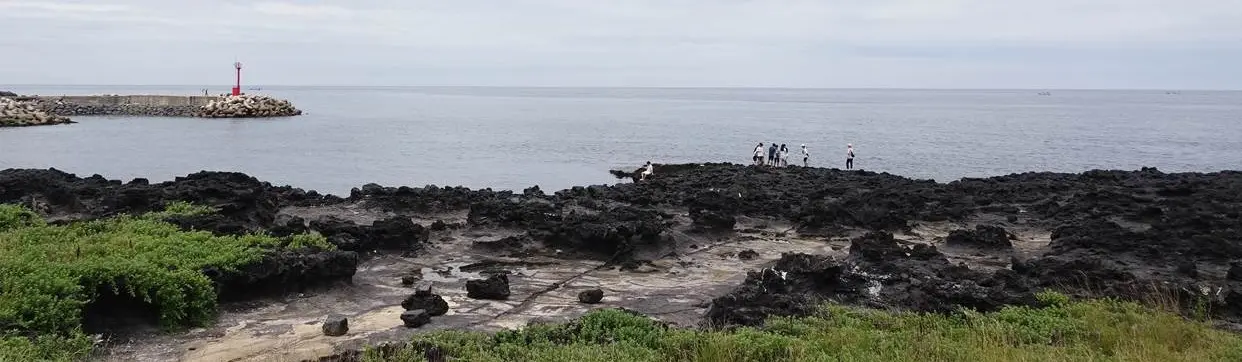
KAC’s current Korean Route 600 page lists the airport-to-Seogwipo KAL Hotel service via Jungmun, with a published airport first departure of 06:30, last departure of 22:20 and a listed 16–40 minute interval. Those details should still be rechecked for the travel date. The important decision point is that a direct route exists; it does not prove that sleeping in Jungmun or Seogwipo is efficient for every one-night trip.
The south works when A is already a Jungmun or Seogwipo evening, B is another south-side breakfast, trail, waterfall or booked activity, and your departure flight leaves enough room to return north. If day two requires you to start heading for the airport before lunch, crossing south for one night of atmosphere often creates more transport than travel. Use the existing Seogwipo accommodation hub only after those two south-side blocks are real.
A rental car removes transfers, not pickup, return and shuttle time
KAC still directs rental-car users toward the Rental Car House and operator shuttle area, and explicitly tells travelers to confirm details with the individual company. On a four- or five-day trip that is a routine fixed cost. On a 2D1N trip, it can consume a meaningful fraction of both arrival and departure windows. Renting a car simply because “Jeju needs a car” can lead to spending the first afternoon collecting it and the second afternoon already planning the return.
A car earns its place when A and B already point in the same direction and driving connects several dispersed stops on that route. If the driving decision is still open, start with whether you actually need a rental car in Jeju. Do not use the car as an excuse to keep an itinerary that was geographically overbuilt from the start.
Without a car, stay near the first useful service—not the largest number of attractions
For a no-car one-night trip, every transfer is expensive because there are only two half-days to spend. Routes 101, 102 and 600 provide east, west and south transport spines, but timetables, stops and the final hotel leg remain date-specific. Use the Jeju no-car guide to verify the actual route before booking the room. A hotel that looks “close to the coast” is not a good short-stay choice if you still drag luggage through a long final leg after the bus.
Families, older travelers, strollers and multiple large bags should weight this even more heavily. Each extra transfer between A and B is part of the accommodation cost. Short trips often fail because “we only have two days” gets translated into “we should add more.” In reality, the shorter the trip, the more aggressively you should delete dependencies.
Do not pay for a resort spec sheet you have no time to use
One-night resort math is easy to get wrong. Pool, spa, breakfast, sea-view common areas and multiple restaurants can all be technically available while your itinerary gives you almost no time to use them. If you arrive after dinner and leave early for an east-coast day, those facilities have very little practical value no matter how good the property looks on an OTA page.
The opposite case is valid: if the resort itself is A—afternoon check-in, pool or beach, dinner, sleep and breakfast—then the hotel is the trip product rather than a logistics node. That is a different intent from a 2D1N sightseeing sprint. Use the one-night resort decision separately rather than scoring both trips with the same checklist.
Eight questions before payment
- After landing, when can I realistically leave the terminal?
- What is the final place on day one where I truly expect to stay into the evening?
- What is the first thing on day two that I cannot be late for or do not want to drop?
- Do A and B sit on the same east, west, south or north travel line?
- Without a car, have I checked the actual first/last useful service and the final hotel leg?
- With a car, have I counted rental pickup, return and shuttle time?
- Will I genuinely use the hotel facilities for at least a meaningful block of time?
- After checkout, where does the luggage go and how long will I carry it?
If question 4 is “no,” do not immediately search for a midpoint hotel. Remove one anchor first. If questions 6 or 8 are still fuzzy, a simpler north-side overnight is often a better purchase than pushing uncertainty into the only morning you have.
Verdict: the best 2D1N hotel is the one that does not make day two repay day one’s geography
Jeju can work for two days and one night, but the hotel has to serve the route more ruthlessly than it would on a longer trip. The north wins on low friction. The east wins when it moves a hard morning clock closer. The west works when sunset and the next morning are both westbound. The south needs the most generous flight window. There is no one-night hotel that meaningfully serves the whole island.
What you need is a clean seam: finish day one without a pointless backtrack, sleep, then begin day two without first undoing last night’s decision. If you still need two or more major directions after this test, the answer is not a more clever hotel. It is another night. Compare the 3-day Jeju version before paying for a 2D1N itinerary that only works on paper.
KriNavi decision card
Best use of this page: With only one night in Jeju, the hotel is not your “island base.” It is the seam between where day one truly ends and where day two must begin.
Core judgement: Use Jeju 2 Days 1 Night to compare the route, timing and practical trade-offs before finalising the trip.
This card only reorganizes sources already listed by the page. Recheck live hours, prices, service, and restrictions for the travel date.